SUBSCRIBE to our monthly NEWSLETTER
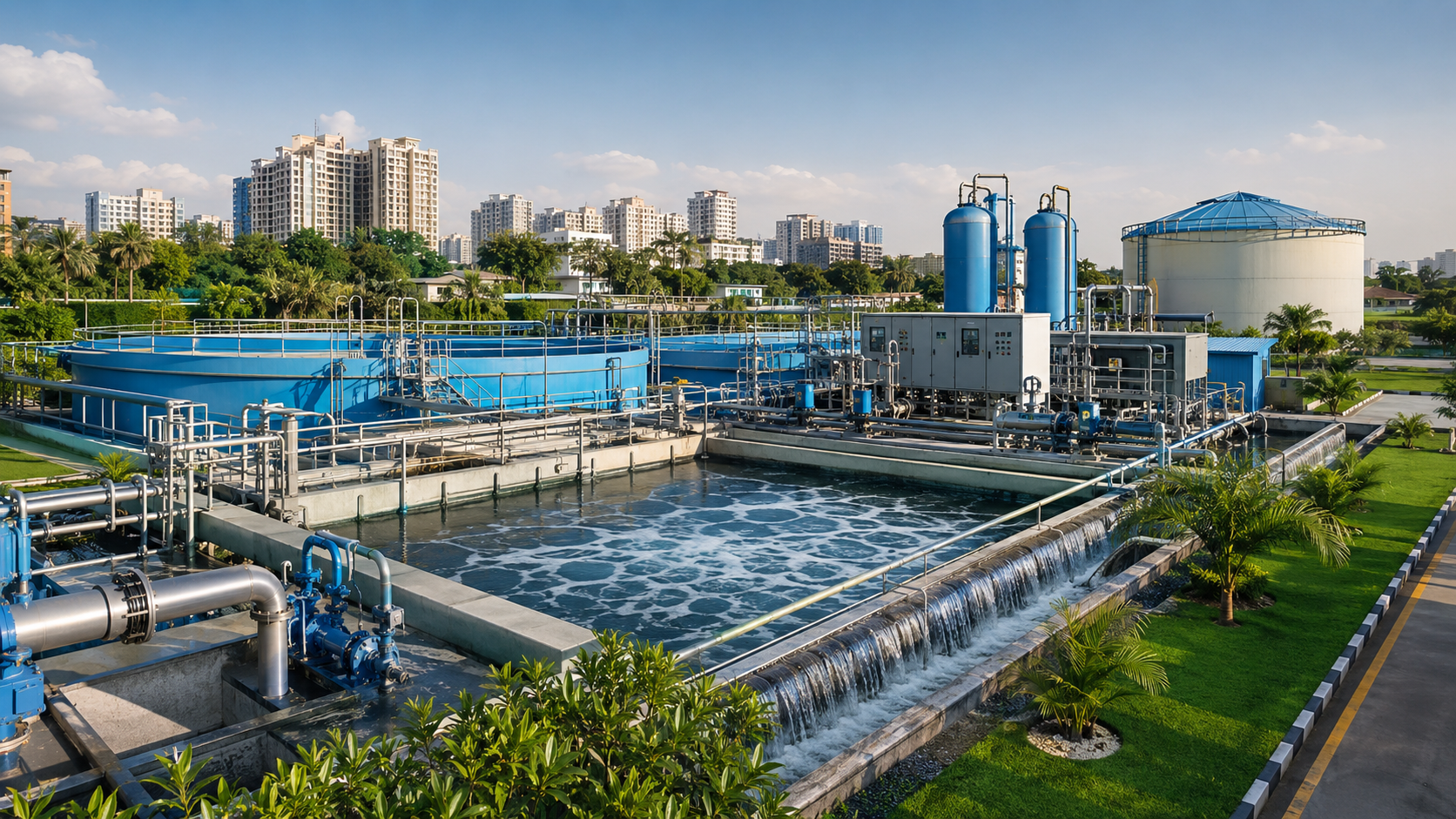
Hyderabad is one of India’s rapidly developing cities, with continuous growth in residential communities, commercial buildings, hotels, hospitals, educational institutions, industries and infrastructure projects. With this growth comes an increase in domestic wastewater generation, making effective sewage treatment an important part of modern development.
A sewage treatment plant (STP) is designed to treat wastewater generated from residential, commercial and institutional facilities before the treated water is discharged or reused for suitable non-potable applications. Selecting the right technology, capacity and service provider is essential for achieving consistent treatment performance and manageable operating requirements.
If you are looking for a sewage treatment plant manufacturer in Hyderabad, this guide explains STP technologies, capacity selection, treatment processes, installation, maintenance, costs, applications and the factors to consider before selecting an STP solution provider.
A sewage treatment plant is an engineered system used to treat wastewater generated from toilets, bathrooms, kitchens and other domestic activities. Sewage typically contains suspended solids, organic matter, nutrients, microorganisms and other contaminants that need to be reduced through appropriate treatment processes.
An STP uses a combination of physical, biological and, where required, tertiary treatment processes to improve wastewater quality.
The treatment process can include:
The exact configuration depends on the sewage characteristics, required treated-water quality, plant capacity, available space and intended reuse application.
For example, an STP designed for a residential apartment may have different requirements from a plant designed for a hospital, hotel, industrial campus or municipal project.
Rapid urban development increases the amount of wastewater generated every day. Residential apartments, gated communities, commercial buildings, hotels, hospitals and institutions all require appropriate wastewater management systems.
An appropriately designed STP can help projects:
For large residential and commercial developments, wastewater treatment should be considered during the early stages of project planning rather than after construction is completed.
This is why developers and facility owners often search for a sewage treatment plant solution provider in Hyderabad that can provide engineering, manufacturing, installation, commissioning and after-sales support.
Although different STP technologies use different processes, the overall treatment objective is to reduce solids, organic matter and other contaminants from sewage.
The first stage generally involves screening.
Screens remove larger materials such as:
Removing these materials protects downstream pumps, blowers and treatment equipment.
Biological treatment is one of the most important stages of an STP.
Microorganisms consume and break down biodegradable organic matter present in sewage. Depending on the selected technology, this biological process may occur using suspended microorganisms, attached-growth media or membrane-supported biological treatment.
Proper aeration, mixing and biological conditions are important for stable operation.
After biological treatment, the wastewater may pass through a clarification stage where biological solids are separated from the treated water.
The separated sludge may be returned to the biological process or removed for appropriate sludge management.
Where higher-quality treated water is required, additional treatment can be provided.
Depending on the application, tertiary treatment may include:
The treatment configuration should be selected according to the intended reuse requirement.
Treated wastewater can potentially be reused for suitable non-potable applications after meeting the required quality criteria.
Possible applications include:
The required treatment level should always be determined based on the intended application and applicable requirements.
There is no single STP technology suitable for every project. The appropriate solution depends on capacity, land availability, sewage characteristics, treated-water requirements, power availability, operating model and budget.
Moving Bed Biofilm Reactor, commonly known as MBBR, uses specially designed media inside the biological reactor.
Microorganisms grow on the surface of the media and help break down organic matter.
MBBR systems can be considered for residential, commercial and institutional applications where continuous biological treatment is required.
Important factors include:
Sequencing Batch Reactor, or SBR, performs different treatment stages in the same reactor in a sequential cycle.
Typical stages can include:
SBR technology can be useful where automation and process control are important.
It can be considered for:
Membrane Bioreactor, or MBR, combines biological treatment with membrane filtration.
The membrane system can provide high-quality treated water and can be useful where treated-water reuse and limited space are important considerations.
MBR systems generally require careful operation and maintenance of membranes and associated equipment.
Compact packaged STPs can be considered for projects where simplified installation, limited space or faster deployment is important.
Depending on the design, compact STPs can provide biological treatment within a relatively small footprint.
GreenSew’s easySTP range is designed as a simplified sewage treatment solution for suitable applications, with an emphasis on practical operation and reduced complexity.
Municipal projects generally involve significantly larger sewage flows and require detailed engineering, hydraulic design, automation, process control and monitoring.
Large municipal systems may incorporate:
The final configuration depends on project capacity and technical specifications.
Choosing an STP should not be based only on the purchase price.
A suitable solution should consider the complete lifecycle of the plant.
Important factors include:
The first step is determining the expected sewage generation.
Capacity is generally expressed in KLD, meaning kilolitres per day.
Examples include:
Land availability can influence technology selection.
Projects with limited space may require compact or higher-loading treatment systems, while projects with larger land availability may have more configuration options.
The required treated-water quality depends on the intended reuse.
For example, water intended for landscaping may have different requirements from water intended for toilet flushing or advanced reuse.
Blowers, pumps, mixers and other mechanical equipment contribute to energy consumption.
Power requirements should therefore be considered during technology selection.
The complexity of operation can vary significantly between different STP technologies.
Project owners should understand:
Sludge is an important part of STP operation.
The selected system should include an appropriate approach for sludge collection, dewatering, handling and disposal.
An STP is a long-term operating asset. Availability of technical support and maintenance services can therefore be important.
One of the most common questions is:
“How do I calculate the required STP capacity?”
The calculation generally starts with estimating the population or facility occupancy and water consumption.
A simplified approach is:
Population × Water Consumption × Sewage Generation Factor = Estimated Sewage Generation
For example, if a residential development has 200 occupants and the estimated water consumption is 135 litres per person per day:
200 × 135 = 27,000 litres/day
This equals approximately:
27 KLD water consumption
If a suitable percentage is considered as sewage generation, the resulting sewage flow can be used as the basis for preliminary STP capacity planning.
However, actual STP design should consider the project’s specific water balance, occupancy, peak flow, commercial activities and applicable design criteria.
Therefore, an STP capacity should not be selected simply by guessing based on the number of residents.
The required capacity varies significantly according to the facility.
Application | Typical Capacity Range |
Small Residential Buildings | 5–20 KLD |
Apartments | 20–500+ KLD |
Hotels | 20–500+ KLD |
Hospitals | 50–500+ KLD |
Schools & Institutions | 10–200 KLD |
Commercial Buildings | 20–500+ KLD |
Large Infrastructure Projects | 500 KLD–Multi-MLD |
Municipal Projects | 1 MLD and above |
These are indicative ranges only. Actual capacity should be calculated from project-specific water consumption and sewage-generation data.
Selecting an STP manufacturer is an important project decision.
Instead of comparing suppliers only by price, consider the complete technical and service capability.
The manufacturer should understand:
Quality of tanks, piping, pumps, blowers, electrical systems and other components affects long-term plant performance.
A complete solution should ideally include:
Post-installation support may include:
Modern STPs can incorporate automation systems such as PLC, HMI, SCADA and online monitoring depending on project requirements.
Automation can help operators monitor plant operation and identify issues more efficiently.
Another common search query is:
“What is the sewage treatment plant cost in Hyderabad?”
There is no single fixed STP price because the cost depends on several factors.
These include:
For example, a compact 20 KLD plant and a 500 KLD plant have very different equipment, installation and operating requirements.
Similarly, an MBR system may have different capital and operating requirements from an MBBR or SBR system.
Therefore, project owners should request a site-specific technical and commercial proposal rather than relying on a generic online price.
A professional STP project generally follows several stages.
The project requirement is collected, including capacity, facility type and treated-water reuse requirements.
Available space, access, electrical supply, existing drainage and installation conditions are evaluated.
Expected sewage generation and peak flow are considered.
An appropriate treatment technology is selected based on project requirements.
Process design, equipment sizing and layout are developed.
Tanks, equipment and associated systems are manufactured or assembled.
The plant and equipment are transported to the project location.
Mechanical, electrical and piping works are completed.
Equipment is tested and the treatment process is commissioned.
The plant enters regular operation with appropriate monitoring and maintenance.
Even a technically sound STP can experience problems if it is incorrectly operated or poorly maintained.
Possible causes can include inadequate aeration, septic conditions, poor sludge management or improper operation.
This can result from:
Improper blower sizing, inefficient equipment, excessive aeration or poor process control can contribute to higher energy consumption.
Sludge production varies according to the technology and operating conditions. Proper sludge management should therefore be incorporated into plant design.
Routine inspection and preventive maintenance can help identify mechanical and electrical problems before they become major failures.
A complicated system may require trained personnel. Selecting a technology that matches the project’s available operating capability is therefore important.
Regular maintenance is essential for consistent plant performance.
Typical activities can include:
The maintenance schedule should be developed according to the equipment manufacturer’s recommendations and project operating conditions.
Sewage treatment solutions are used across many sectors.
Apartments and gated communities generate sewage every day and require appropriately sized treatment systems.
Hotels can have varying occupancy levels and significant wastewater generation from rooms, restaurants and other facilities.
Hospitals require carefully designed wastewater management systems because their wastewater characteristics can differ from normal residential sewage.
Educational campuses may require STPs based on student, staff and facility occupancy.
Office buildings, shopping facilities and IT campuses can generate substantial quantities of domestic wastewater.
Industrial sites may require separate evaluation of domestic sewage and industrial effluent. Where industrial wastewater is involved, an ETP or combined wastewater management strategy may be required.
Large public infrastructure projects require detailed planning, hydraulic design, process selection, automation and monitoring.
Water reuse is becoming an important part of sustainable water management.
Instead of treating wastewater only as a waste stream, properly treated wastewater can potentially become a useful resource for suitable non-potable applications.
For example, treated water can be considered for:
This can reduce demand for freshwater for applications that do not require potable water.
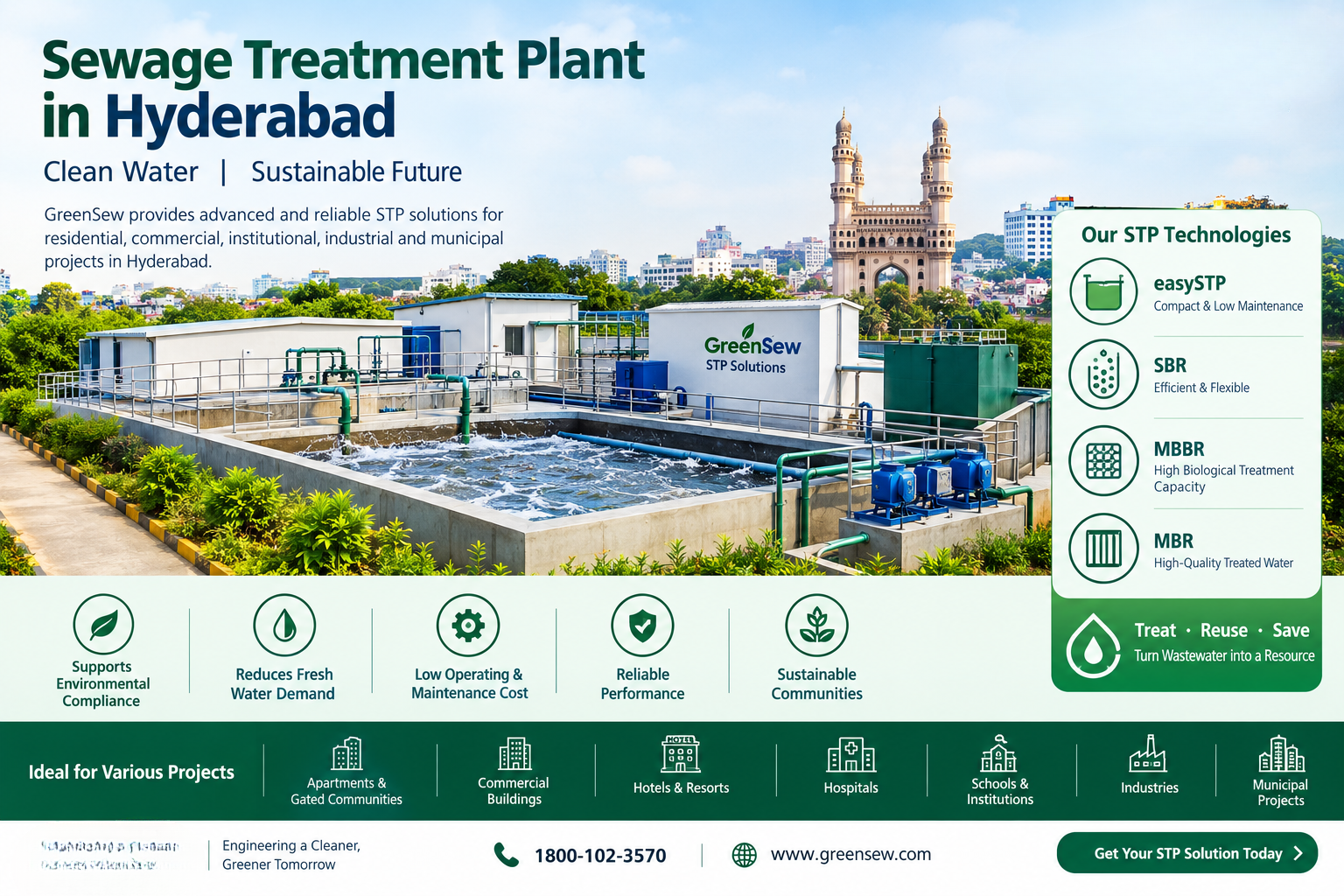
GreenSew provides sewage treatment solutions for residential, commercial, institutional and infrastructure projects.
Its solution portfolio includes:
The objective is to develop practical sewage treatment solutions based on project capacity, site conditions, operational requirements and treated-water reuse objectives.
For project owners looking for a sewage treatment plant manufacturer and solution provider in Hyderabad, the focus should be on engineering suitability, long-term operation, service support and overall lifecycle requirements.
An STP is an engineered system that treats domestic wastewater by using physical, biological and, where required, tertiary treatment processes.
The suitable technology depends on capacity, available space, treated-water requirements, operating conditions, power availability and maintenance requirements. MBBR, SBR, MBR and compact STP solutions can be considered depending on the project.
The cost depends on capacity, technology, equipment, tank material, automation, filtration, installation and other project-specific requirements. A customized quotation is required for accurate pricing.
STP capacity can be estimated using population or facility occupancy, water consumption and expected sewage generation. Peak flow and project-specific requirements should also be considered during detailed design.
Space requirements depend on plant capacity, technology, tank configuration, equipment layout and whether the system is compact or conventional.
Maintenance frequency depends on the technology and equipment. Pumps, blowers, filters, electrical systems and other components should be inspected according to recommended maintenance schedules.
Yes, treated wastewater can potentially be reused for suitable non-potable applications when it meets the required quality criteria and applicable requirements.
MBBR uses attached-growth biological media, SBR treats wastewater through sequential batch cycles, while MBR combines biological treatment with membrane filtration. Each technology has different operational and application considerations.
Consider the company’s engineering capability, manufacturing quality, technology options, installation and commissioning support, automation capability, maintenance services and long-term technical support.
Choosing the right sewage treatment plant involves more than selecting equipment based on capacity or initial price. The technology, hydraulic design, sewage characteristics, available space, treated-water requirements, power consumption, operation, maintenance and lifecycle cost should all be considered.
For residential, commercial, institutional and infrastructure projects, working with an experienced sewage treatment plant manufacturer in Hyderabad can help simplify the process from requirement assessment through design, manufacturing, installation and commissioning.
If you are planning an STP project in Hyderabad, start by determining your expected sewage generation, available space, required treated-water quality and intended reuse application.
Need a Sewage Treatment Plant in Hyderabad?
GreenSew can help evaluate your project requirement and develop a suitable sewage treatment solution based on capacity, site conditions and operational requirements.
Contact GreenSew for a project-specific STP consultation and quotation.

With over two decades in the water treatment business, I pioneered bulk pure water distribution and now lead the way in sustainable sewage treatment with easySTP, inspired by Japan’s Johkasou technology. My vision includes widespread adoption and expansion through a new factory and sewage academy.
With over two decades in the water treatment business, I pioneered bulk pure water distribution and now lead the way in sustainable sewage treatment with easySTP, inspired by Japan’s Johkasou technology. My vision includes widespread adoption and expansion through a new factory and sewage academy.
SUBSCRIBE to our monthly NEWSLETTER