SUBSCRIBE to our monthly NEWSLETTER
How to Choose the Right Sewage Treatment Plant for Your Project: A Complete Guide
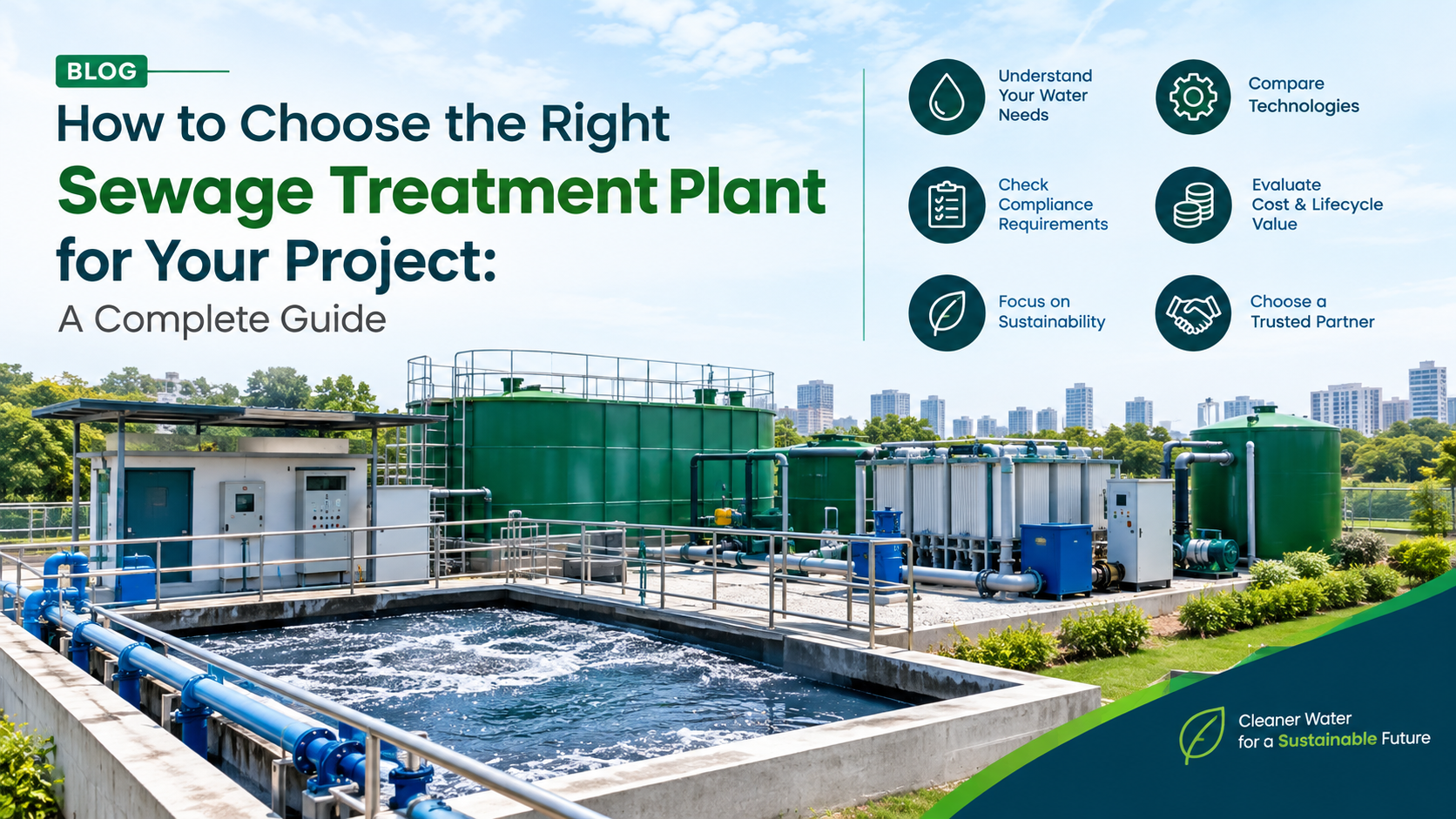
Choosing the right sewage treatment plant (STP) is an important decision for residential apartments, commercial buildings, hotels, hospitals, educational institutions, and industrial developments. An appropriately designed sewage treatment plant helps manage wastewater, meet applicable environmental requirements, reduce freshwater consumption through reuse, and support long-term operational efficiency.
However, selecting an STP involves more than comparing equipment prices. Project owners must consider sewage generation, treatment capacity, available installation space, treatment technology, electricity consumption, maintenance requirements, treated water quality, and the manufacturer’s technical support.
Whether you are planning a new residential community, upgrading an existing wastewater treatment facility, or searching for a reliable sewage treatment plant manufacturer in India, understanding these factors can help you make an informed decision.
In this guide, we explain how to choose the right sewage treatment plant for your project, compare common treatment technologies, estimate capacity requirements, understand operating costs, and identify the key factors to evaluate before purchasing an STP.
1. Understand Your Project’s Sewage Treatment Requirements
The first step in selecting the right sewage treatment plant is understanding the type of project and the wastewater it generates. Different buildings have different occupancy patterns, water consumption levels, wastewater characteristics, and treatment requirements.
A sewage treatment plant designed for an apartment complex may not be suitable for a hospital or industrial facility without appropriate modifications.
Sewage Treatment Plant for Residential Apartments
Residential apartments and gated communities generate wastewater from bathrooms, kitchens, washing areas, and toilets. The required treatment capacity depends on the number of residents, water consumption, occupancy levels, and future expansion plans.
When choosing a sewage treatment plant for an apartment building, consider:
- Number of apartments and expected occupants.
- Average daily water consumption per person.
- Estimated sewage generation.
- Space available for installation.
- Treated water reuse for gardening and toilet flushing.
- Electricity consumption and maintenance requirements.
For residential projects with limited installation space, a compact sewage treatment plant may offer a practical solution.
STP for Commercial Buildings
Office buildings, shopping malls, restaurants, and business centres experience varying wastewater generation depending on occupancy and operating hours.
A commercial sewage treatment plant should be designed around expected peak loads, daily usage patterns, the nature of the wastewater, and applicable discharge or reuse requirements.
Sewage Treatment Plants for Hotels and Hospitals
Hotels generate wastewater from guest rooms, kitchens, laundry facilities, and common areas. Hospitals may produce wastewater with characteristics that require additional assessment and appropriate treatment provisions.
A sewage treatment plant for hotels or hospitals should therefore be designed according to the specific wastewater profile, applicable standards, and intended reuse or discharge arrangements.
Industrial Wastewater Treatment Requirements
Industrial facilities may generate process wastewater in addition to domestic sewage. Depending on the industry, separate pretreatment or a dedicated effluent treatment plant (ETP) may be necessary.
Before selecting an STP for an industrial project, determine whether the wastewater is primarily domestic sewage, industrial effluent, or a combination of both.
Understanding these requirements helps engineers select the appropriate treatment process and avoid unnecessary equipment or inadequate treatment performance.
2. Calculate the Required Sewage Treatment Plant Capacity
One of the most important factors when choosing a sewage treatment plant is its treatment capacity. An undersized STP may struggle during peak usage, while an unnecessarily oversized plant may increase initial investment and operating costs.
STP capacity is commonly expressed in KLD, meaning kilolitres per day. One kilolitre equals 1,000 litres.
How to Estimate Sewage Generation
A preliminary estimate can be calculated using the following formula:
Daily sewage generation = Number of occupants × Daily water consumption per person × Sewage generation factor
For example, consider a residential project with 200 occupants.
Assume:
- Occupancy: 200 people.
- Water consumption: 135 litres per person per day.
- Assumed sewage generation factor: 80%.
Estimated daily sewage generation:
200 × 135 × 80% = 21,600 litres per day, or 21.6 KLD.
This is an illustrative calculation, not a final design recommendation. Actual water consumption, wastewater generation, local design criteria, peak flows, and the nature of the project must be verified before finalising plant capacity.
Factors That Influence STP Capacity
When calculating sewage treatment plant capacity for residential buildings or commercial projects, consider:
- Current and expected occupancy.
- Daily water consumption.
- Peak-hour and seasonal variations.
- Wastewater from kitchens, laundry, and other facilities.
- Future building expansion.
- Infiltration or other additional flows, where relevant.
- Organic loading and wastewater characteristics.
Capacity selection should account for both hydraulic loading and organic loading. Two projects generating the same wastewater volume may require different treatment configurations if their wastewater characteristics differ.
A qualified wastewater engineering team can assess these factors and recommend a suitable plant configuration.
3. Compare Different Sewage Treatment Plant Technologies
Sewage treatment plants use different biological and physical processes to remove contaminants from wastewater. Selecting the right technology depends on the required effluent quality, available space, operating budget, automation requirements, and maintenance capabilities.
The following technologies are commonly considered for building and community wastewater treatment projects.
MBBR Sewage Treatment Plant
MBBR stands for Moving Bed Biofilm Reactor. This technology uses specialised carrier media that support the growth of microorganisms responsible for biological treatment.
Potential advantages:
- Compact biological treatment configuration.
- Biofilm-based treatment process.
- Suitable for a range of domestic sewage applications.
- Can be designed for different capacities and loading conditions.
Key considerations:
The system still requires appropriate aeration, screening, sludge management, and process control. Performance depends on the design, loading conditions, and operation of the complete treatment plant.
MBBR sewage treatment plants may be suitable for residential and commercial projects where the technology meets the required treatment objectives.
SBR Sewage Treatment Plant
SBR stands for Sequencing Batch Reactor. It performs biological treatment in a sequence of operating stages within a reactor, typically including filling, reaction, settling, and decanting.
Potential advantages:
- Multiple treatment stages can occur in the same reactor.
- Suitable for applications where batch-cycle operation is appropriate.
- Can be automated to manage treatment cycles.
- May offer flexibility in process control.
Key considerations:
Cycle timing, hydraulic equalisation, controls, decanting arrangements, and operator understanding are important for reliable performance.
An SBR sewage treatment plant can be considered for projects requiring a carefully controlled biological treatment process.
MBR Sewage Treatment Plant
MBR stands for Membrane Bioreactor. It combines biological treatment with membrane filtration to separate treated water from suspended solids.
Potential advantages:
- Produces low-suspended-solids effluent when properly designed and operated.
- Can support compact plant layouts.
- May be suitable where higher-quality treated water is required for specified reuse applications.
Key considerations:
Membrane fouling, cleaning, replacement costs, energy consumption, and maintenance procedures must be evaluated.
MBR technology may be appropriate when the project requires the additional treatment performance that membrane separation can provide.
Compact Packaged Sewage Treatment Plants
Compact packaged STPs integrate treatment components into a space-efficient configuration. Depending on the design, these systems may use different biological treatment processes and equipment arrangements.
They can be useful for apartments, hotels, institutions, and commercial properties where space, installation time, and operational simplicity are important considerations.
For example, Indus ecowater’s easySTP solutions can be evaluated for projects seeking compact wastewater treatment. The suitable model and configuration should be confirmed against the project’s capacity, site conditions, and treatment requirements.
Which Sewage Treatment Technology Is Best?
There is no single technology that is best for every project.
When comparing MBBR vs SBR vs MBR sewage treatment plants, assess the following:
- Required treated water quality.
- Available installation area.
- Capital and operating costs.
- Electricity consumption.
- Sludge handling requirements.
- Automation and maintenance needs.
- Availability of trained operators.
- Manufacturer support and process guarantees.
Request a project-specific technical comparison instead of selecting a technology based only on its name or initial price.
4. Evaluate Available Installation Space and Site Conditions
Installation space can significantly influence the design of a sewage treatment plant, especially in urban areas where underground utilities, parking, landscaping, and building foundations limit available land.
Before selecting an STP, evaluate the proposed location and access requirements.
Underground and Ground-Level Installation
Underground sewage treatment plants can help preserve usable surface space, but they require appropriate structural design, waterproofing, ventilation, and safe maintenance access.
Ground-level installations may provide easier access for inspections and servicing, depending on the site layout.
The final arrangement should account for civil works, equipment access, drainage, electrical connections, and local site conditions.
Why Compact STPs Matter
A compact sewage treatment plant for apartments or commercial buildings may help projects use available space more efficiently.
However, compactness should not come at the expense of essential treatment stages, access for maintenance, or safe operation.
When evaluating a compact STP, ask the manufacturer to provide the equipment layout, required footprint, access clearances, and civil installation requirements.
Noise and Odour Control
Poorly managed sewage treatment facilities can create noise and odour concerns for occupants and neighbouring properties.
Consider suitable ventilation, process design, enclosure requirements, screening, sludge management, and equipment selection. Noise and odour performance should be evaluated using the actual plant configuration rather than general claims.
5. Understand Sewage Treatment Plant Cost in India
The cost of a sewage treatment plant in India varies considerably depending on capacity, treatment technology, equipment specifications, site conditions, and required treated water quality.
A reliable quotation should clearly identify the scope of supply and installation rather than provide only a headline price.
Initial Installation Cost
The capital cost of an STP may include:
- Treatment tanks and process equipment.
- Pumps, blowers, and associated machinery.
- Electrical panels and automation.
- Piping, valves, and instrumentation.
- Civil construction and foundations.
- Transportation and installation.
- Testing and commissioning.
- Operator training and documentation.
The exact scope varies by project and supplier.
Operating and Maintenance Costs
The purchase price is only one part of the total cost of owning a sewage treatment plant.
Ongoing expenses may include electricity, routine maintenance, chemicals where required, replacement components, sludge handling, laboratory testing, and operator costs.
When comparing quotations, ask suppliers to explain expected operating requirements and the assumptions used in their estimates.
Why Lifecycle Cost Matters
A plant with a lower initial price may not be the most economical choice over its operating life if it requires excessive energy, frequent repairs, or intensive maintenance.
Compare the total cost of ownership over a consistent period, using the same assumptions for electricity tariffs, operating hours, staffing, consumables, and maintenance.
This approach helps developers and property owners make a more informed investment decision.
6. Check Regulatory and Treated Water Quality Requirements
A sewage treatment plant must be designed to meet the requirements applicable to its location, project category, discharge arrangement, and intended reuse application.
In India, applicable requirements may involve the Central Pollution Control Board (CPCB), the relevant State Pollution Control Board (SPCB), local authorities, and project-specific approval conditions.
Verify the Required Effluent Standards
Before finalising the STP design, confirm:
- Whether treated water will be discharged or reused.
- Applicable effluent quality limits.
- Requirements for sampling and testing.
- Monitoring and reporting obligations, where applicable.
- Relevant consent and approval requirements.
- Any project-specific conditions.
Do not assume that one set of treated water parameters applies to every location and use.
Plan for Monitoring and Compliance
The selected system should provide suitable access for sampling, maintenance, and process monitoring.
Depending on project requirements, monitoring provisions may include flow measurement, pH measurement, and other specified parameters. Online monitoring equipment may be required in certain circumstances.
Confirm these requirements with the relevant authority or qualified environmental consultant before purchasing equipment.
7. Evaluate Automation, Operation and Maintenance
Even a well-designed sewage treatment plant needs appropriate operation and maintenance. Neglecting routine inspections or allowing equipment failures to continue can reduce treatment performance and disrupt reuse or discharge arrangements.
For this reason, operating simplicity should be an important selection criterion.
Manual Versus Automated STPs
Manual systems may require more operator involvement in routine activities. Automated systems can use control panels, sensors, timers, and alarms to support process operation.
Automation can improve consistency, but it does not eliminate the need for inspection, cleaning, servicing, and performance checks.
Remote Monitoring and Alarms
Where suitable, remote monitoring can help authorised personnel identify equipment faults and operational abnormalities.
Before selecting an automated STP, verify which parameters are monitored, how alarms are communicated, and who is responsible for responding to them.
Maintenance and After-Sales Support
Evaluate the manufacturer’s maintenance documentation, spare-parts availability, warranty conditions, service arrangements, and operator training.
Ask whether the supplier can provide preventive maintenance support or an annual maintenance contract.
For property owners who do not have specialised wastewater staff, clear operating procedures and accessible technical support can be particularly valuable.
8. Consider Treated Wastewater Reuse Opportunities
An efficiently operated sewage treatment plant can support water conservation by making treated wastewater available for suitable non-potable applications.
Instead of sending all treated water for disposal, a project may be able to reuse an appropriate portion of it, depending on treatment quality, local requirements, and the site’s demand.
Common Applications for Treated Water
Potential applications include:
- Landscape irrigation and gardening.
- Toilet flushing.
- Approved cleaning and other non-potable uses.
- Certain industrial or utility applications, subject to additional treatment and quality requirements.
Not every application is suitable for every treated water quality. Additional filtration, disinfection, or other treatment may be necessary.
Plan the Reuse System Along With the STP
The reuse arrangement should be considered during the initial design.
This includes treated water storage, pumping, distribution piping, any additional treatment stages, and appropriate identification of non-potable water systems.
The volume of water available for reuse should also be compared with actual demand. A properly planned system can help reduce freshwater consumption while supporting responsible wastewater management.
9. Choose a Reliable Sewage Treatment Plant Manufacturer
Selecting the right manufacturer is as important as selecting the treatment technology. The supplier should understand the project’s engineering requirements and be able to support the plant beyond installation.
When searching for a reliable sewage treatment plant manufacturer in India, evaluate the following factors.
Engineering and Design Capabilities
Ask how the supplier determines capacity, selects treatment technology, and develops the process design.
The proposal should explain the treatment process, design assumptions, equipment specifications, expected performance, and project exclusions.
Relevant Project Experience
Review comparable installations in terms of capacity, building type, treatment technology, and operating conditions.
Project references and installation photographs can help you assess the supplier’s experience, but verify technical and performance claims before relying on them.
Installation and Commissioning Support
A supplier should clearly define responsibilities for delivery, installation, testing, commissioning, and operator training.
Confirm which civil works, electrical connections, piping, and site services are included in the quotation.
Warranty and Long-Term Support
Check warranty coverage, exclusions, spare-parts availability, preventive maintenance services, and response arrangements.
Reliable after-sales support can make a significant difference to the long-term operation of an STP.
Consider Indus ecowater for Your STP Project
Indus ecowater Infratech is an engineering organisation providing sewage treatment and wastewater management solutions for different project requirements.
Its portfolio includes technologies and solutions such as easySTP, easySBR, MBBR, MBR, sewage recycling, and municipal wastewater treatment systems.
For developers, consultants, contractors, and property owners, the selection process should begin with a clear understanding of the project’s sewage generation, site constraints, required treatment quality, and operational expectations.
Explore the relevant solutions on the Indus ecowater website and discuss your project requirements with the team to identify a suitable treatment configuration.
10. Common Mistakes to Avoid When Selecting an STP
Avoiding a few common mistakes can improve the reliability and long-term value of your sewage treatment investment.
Choosing the wrong capacity: Do not base capacity only on the number of apartments or the building’s current occupancy. Estimate actual sewage generation and assess future requirements.
Selecting technology based only on price: Compare treatment performance, operating costs, maintenance requirements, and the complete supply scope.
Ignoring space and access: Ensure that operators can safely inspect and maintain the equipment.
Overlooking electricity consumption: Ask for realistic operating estimates and clarify the equipment covered by the energy calculation.
Neglecting treated water reuse: Determine the intended use and corresponding quality requirements before finalising the treatment process.
Failing to verify compliance: Confirm the requirements that apply to the particular project and location.
Ignoring after-sales service: Review warranty terms, technical support, operator training, and the availability of spare parts.
Accepting unclear performance commitments: Request written design criteria, testing procedures, and performance guarantees that specify the conditions under which they apply.
11. Sewage Treatment Plant Selection Checklist
Before approving a quotation or placing an order, use this checklist to assess whether the proposed system meets your project’s needs.
- Building type and expected occupancy identified.
- Daily sewage generation estimated in KLD.
- Hydraulic and organic loading assessed.
- Future expansion requirements considered.
- Treatment technology justified against project needs.
- Installation footprint and access requirements confirmed.
- Civil and electrical scope clearly documented.
- Capital cost and operating expenses evaluated.
- Treated water quality and reuse requirements confirmed.
- Applicable regulatory requirements reviewed.
- Automation and maintenance arrangements understood.
- Warranty, commissioning, and service support verified.
- Technical specifications and performance commitments documented.
A structured evaluation makes it easier to compare suppliers on a consistent basis and select an STP that meets the project’s technical, financial, and operational requirements.
Frequently Asked Questions About Sewage Treatment Plants
1. How do I choose the right sewage treatment plant for my project?
Start by estimating daily sewage generation and identifying the required treated water quality. Then compare suitable technologies, available installation space, capital and operating costs, automation, maintenance needs, and regulatory requirements. Ask an experienced wastewater engineering team to validate the design.
2. What capacity of STP is required for an apartment building?
The required capacity depends on the number of occupants, water consumption, sewage generation factor, and other project-specific conditions. A preliminary estimate can be made using daily water consumption and an appropriate sewage generation factor, but final capacity should be confirmed through engineering assessment.
3. Which is better: MBBR, SBR, or MBR?
MBBR uses attached-growth biological treatment, SBR uses timed treatment cycles, and MBR combines biological treatment with membrane separation. Each has different space, operational, maintenance, and effluent-quality considerations. The right choice depends on the project’s requirements.
4. How much does a sewage treatment plant cost in India?
STP cost varies with capacity, technology, equipment quality, civil works, installation scope, and required treatment performance. Obtain a detailed quotation that includes the relevant supply, installation, commissioning, and operating assumptions.
5. How much space is needed for a sewage treatment plant?
The required footprint depends on capacity, treatment technology, tank arrangement, equipment layout, and site conditions. A compact packaged STP may suit a space-constrained project, but safe access and maintenance clearances must still be provided.
6. Can treated sewage water be reused?
Yes, treated sewage water can be reused for appropriate non-potable applications such as gardening and toilet flushing when the water quality, additional treatment, distribution system, and applicable requirements are suitable.
7. Does an automated sewage treatment plant require maintenance?
Yes. Automation can support routine process control and fault detection, but inspections, equipment servicing, cleaning, sludge management, and treatment-performance monitoring remain necessary.
8. How can I find a reliable sewage treatment plant manufacturer in India?
Review the manufacturer’s engineering capabilities, relevant project experience, technical specifications, equipment quality, commissioning process, warranty terms, and after-sales service. Compare complete proposals rather than choosing solely on initial price.
Conclusion: Choose an STP Designed for Your Project’s Needs
Choosing the right sewage treatment plant requires a balanced assessment of capacity, treatment technology, installation space, capital investment, operating costs, compliance requirements, and long-term maintenance.
A suitable system should not only treat the expected wastewater volume but also deliver the required treatment performance under the project’s actual operating conditions. Planning for treated water reuse, accessible maintenance, and reliable technical support can further improve the long-term value of the installation.
For residential apartments, commercial buildings, hotels, institutions, and other developments, an engineering-led selection process helps reduce avoidable risks and supports dependable wastewater management.
Planning a sewage treatment plant for your project?
Connect with Indus ecowater Infratech to discuss your capacity requirements, site conditions, treatment technology options, and wastewater reuse goals.
Visit Indus Ecowater to explore sewage treatment solutions and enquire about a suitable STP for your project.

Suresh Kumar
With over two decades in the water treatment business, I pioneered bulk pure water distribution and now lead the way in sustainable sewage treatment with easySTP, inspired by Japan’s Johkasou technology. My vision includes widespread adoption and expansion through a new factory and sewage academy.
About Our Author
Suresh Kumar
With over two decades in the water treatment business, I pioneered bulk pure water distribution and now lead the way in sustainable sewage treatment with easySTP, inspired by Japan’s Johkasou technology. My vision includes widespread adoption and expansion through a new factory and sewage academy.
Post categories
- sewage treatment plants
- easySTP
- everything about STP
- Recycle
Recent Posts