SUBSCRIBE to our monthly NEWSLETTER
Rapid urban development, growing residential communities, commercial buildings, hospitals, hotels, educational institutions, and industrial facilities are increasing the demand for reliable wastewater management solutions in Hyderabad. As sewage generation increases, organizations and property developers need efficient systems to treat wastewater before discharge or reuse.
An FRP Prefabricated Sewage Treatment Plant Manufacturer in Hyderabad can provide a practical solution for projects that require a compact, factory-engineered and professionally installed sewage treatment system.
Indus Ecowater provides wastewater treatment solutions designed around project requirements such as sewage generation, available space, treatment objectives, treated-water reuse and operational requirements.
This guide explains what an FRP prefabricated sewage treatment plant is, how it works, its advantages, applications, installation requirements, maintenance considerations, pricing factors and how to select the right STP manufacturer in Hyderabad.
An FRP Prefabricated Sewage Treatment Plant is a factory-manufactured wastewater treatment system designed to treat domestic sewage generated from residential, commercial, institutional or other suitable facilities.
FRP stands for Fibre Reinforced Plastic. FRP is widely used for wastewater-treatment tanks and equipment because of its lightweight construction, corrosion resistance and suitability for prefabricated manufacturing.
Unlike conventional sewage treatment plants that may require extensive construction at the project site, a prefabricated STP is manufactured or assembled in a controlled environment and then transported to the installation location.
This approach can help reduce site construction activities and simplify installation for projects where space and construction time are important considerations.
A typical sewage treatment process may include:
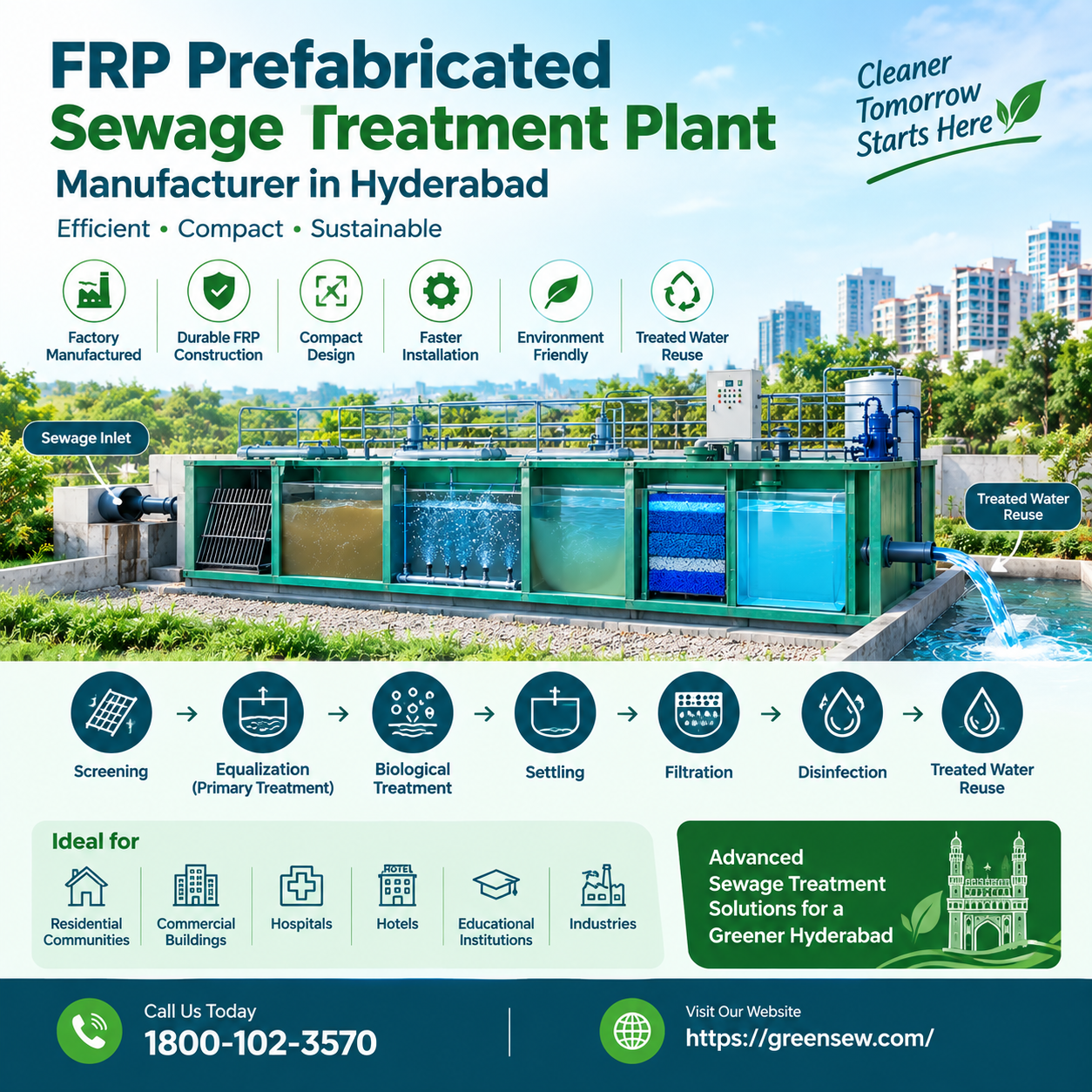
Sewage Inlet → Screening → Biological Treatment → Settling → Filtration → Disinfection → Treated Water Reuse
The exact treatment process depends on the selected technology, plant capacity, influent characteristics and required treated-water quality.
Hyderabad has experienced significant growth in residential and commercial development. Apartments, gated communities, offices, hospitals, hotels, educational campuses and industrial facilities generate substantial quantities of wastewater every day.
Proper sewage treatment is therefore an important part of modern building infrastructure.
For many projects, conventional civil-built STPs can involve considerable construction work, space requirements and project coordination. An FRP prefabricated STP can offer an alternative approach where a factory-engineered and modular system is more suitable.
Some important reasons to consider a prefabricated FRP sewage treatment plant include:
However, the right STP should always be selected based on actual sewage generation, site conditions and treatment requirements rather than simply choosing a plant based on tank material.
Understanding the treatment process is important before selecting an FRP sewage treatment plant manufacturer in Hyderabad.
Although treatment configurations vary, a typical sewage treatment system follows several stages.
Incoming sewage first passes through a screening arrangement.
The screening process removes larger solids such as:
Removing these materials protects downstream equipment and improves the reliability of the treatment process.
The wastewater enters an initial treatment or equalization stage depending on the system design.
The purpose can include:
Equalization can be particularly useful when sewage flow varies significantly during the day.
Biological treatment is the core of most domestic sewage treatment systems.
Microorganisms consume and break down biodegradable organic matter present in sewage.
Depending on the selected STP technology, biological treatment may use processes such as:
Aeration equipment may be used to provide oxygen required by microorganisms.
After biological treatment, suspended biological solids need to be separated from the treated water.
A settling or clarification stage may be used depending on the technology.
The separated sludge is managed through an appropriate sludge-handling process.
Additional filtration may be provided depending on the final treated-water requirements.
Filtration can help reduce remaining suspended particles and improve the appearance and quality of treated water.
A disinfection stage may be used before reuse or discharge.
Common approaches include:
The appropriate method depends on the application and required treated-water quality.
Treated wastewater can potentially be reused for suitable non-potable applications after meeting the required quality criteria.
Potential applications include:
The actual reuse application should be determined based on treated-water quality and applicable requirements.
Choosing an FRP prefabricated STP manufacturer in Hyderabad can be beneficial for projects looking for a modular wastewater-treatment solution.
The system can be manufactured under controlled factory conditions.
This can improve consistency in fabrication and reduce dependence on extensive site construction.
Wastewater environments can be challenging because of moisture and corrosive substances.
FRP offers good corrosion resistance, making it suitable for many wastewater-treatment applications.
Compared with many conventional construction materials, FRP is relatively lightweight.
This can simplify:
Prefabricated systems can reduce the amount of fabrication required at the project site.
This can be useful where construction space is limited or where the project needs to minimize disruption.
Prefabricated STPs can be designed around different capacity requirements.
This allows the system configuration to be selected based on the project’s wastewater-generation requirements.
Because major components are prefabricated, installation can be faster than constructing an entire treatment structure from the beginning at the site.
The actual installation duration depends on:
Compact STP configurations can be useful for:
When selecting a sewage treatment system, project owners often compare FRP prefabricated STP vs RCC STP.
Feature | FRP Prefabricated STP | Conventional RCC STP |
Construction | Factory prefabricated | Mainly site construction |
Installation | Generally faster | Generally longer |
Civil work | May be reduced | Usually substantial |
Transportation | Complete/major components can be transported | Structure built at site |
Corrosion resistance | High | Depends on construction and protection |
Site disruption | Potentially lower | Higher during construction |
Design | Modular/project-specific | Civil structure based |
Space | Compact configurations available | Depends on civil design |
Maintenance | Depends on treatment technology | Depends on treatment technology |
There is no single STP technology that is ideal for every project.
The final choice should consider capacity, available space, budget, treated-water quality, power consumption, operation requirements, sludge management and long-term service support.
One of the most important steps when purchasing an FRP sewage treatment plant in Hyderabad is selecting the correct capacity.
A plant that is too small may struggle during peak flows, while a significantly oversized plant may increase capital and operating costs unnecessarily.
A basic estimation can start with:
Population × Water Consumption × Sewage Generation Percentage = Estimated Sewage Flow
For example:
200 people × 120 litres/person/day = 24,000 litres/day
If approximately 80% becomes sewage:
24,000 × 80% = 19,200 litres/day
Therefore:
Estimated sewage generation = 19.2 KLD
The final STP capacity should not be selected from this calculation alone. Engineers should consider actual occupancy, water sources, peak flow, commercial activity, process characteristics and applicable design criteria.
FRP packaged sewage treatment plants can be considered for a wide range of applications.
Apartments generate domestic wastewater from:
An appropriately designed STP can treat this sewage for suitable reuse or discharge.
Large gated communities may generate significant daily sewage volumes.
A centralized STP can provide wastewater treatment for the community.
Office buildings, shopping complexes and commercial developments require appropriate sewage-treatment infrastructure.
Hotels can generate wastewater from:
STP capacity should account for the property’s actual occupancy and wastewater characteristics.
Healthcare facilities require carefully designed wastewater-management systems. The treatment requirements should be determined based on the nature of wastewater generated and applicable regulations.
Schools, colleges, universities and hostels can use suitable sewage-treatment systems based on their population and daily wastewater generation.
Where industrial facilities generate domestic sewage, an appropriate STP can be used for the domestic wastewater stream.
Industrial process wastewater may require a separate treatment system depending on its characteristics.
Apartments are one of the most important applications for sewage treatment systems.
A typical residential development may have hundreds or thousands of residents, generating sewage every day.
When selecting an FRP sewage treatment plant for apartments in Hyderabad, consider:
For example, treated wastewater may be considered for gardening or flushing applications where the required quality is achieved.
A properly designed reuse system can reduce dependence on fresh water for suitable non-potable applications.
A professional installation process generally follows several stages.
The manufacturer or engineering team evaluates:
The required STP capacity is determined based on sewage generation.
The appropriate treatment technology is selected according to the project requirements.
The STP configuration, tanks, equipment, piping and control system are finalized.
FRP tanks and other required components are manufactured according to the approved design.
The prefabricated equipment is transported to the project location.
Required civil works and foundation arrangements are completed.
The FRP tanks and equipment are positioned and connected.
Required electrical, piping and control-panel connections are completed.
The system is tested and commissioned before regular operation.
Operators can be trained in routine operation, monitoring and basic maintenance.
A common misconception is that a prefabricated sewage treatment plant does not require maintenance.
In reality, every biological sewage treatment plant requires appropriate operation and maintenance.
Regular maintenance may include:
Periodic professional servicing can help identify:
An AMC or professional maintenance program can be considered for projects that require ongoing technical support.
One of the most searched questions is:
“What is the price of an FRP sewage treatment plant in Hyderabad?”
There is no single price applicable to every project.
The cost depends on several factors.
A larger-capacity STP generally requires more equipment and larger treatment volumes.
MBBR, SBR, MBR, Johkasou and other technologies have different equipment and operational requirements.
Tank size, construction specifications and internal configuration affect the cost.
Automatic control systems and monitoring equipment can influence project cost.
Additional filtration and disinfection systems affect the overall project price.
Transportation, installation, electrical and piping work can contribute to the total project cost.
Foundation, excavation and other site-specific civil works may be required.
Warranty, AMC and service requirements should also be considered when comparing quotations.
Therefore, instead of choosing an STP only based on the lowest quotation, buyers should evaluate the total lifecycle cost and technical suitability.
A sewage treatment plant should be designed and operated according to the requirements applicable to the project and location.
Before purchasing an STP, project owners should understand:
It is important not to assume that an STP is automatically compliant simply because it is manufactured from FRP.
FRP describes the construction material; compliance depends on the complete treatment system, design, operation and applicable regulatory requirements.
Selecting the right manufacturer is just as important as selecting the right technology.
Consider these factors before placing an order.
Look for a manufacturer with experience in wastewater-treatment projects similar to yours.
The company should be able to calculate capacity and design the system based on project requirements.
Check the quality of FRP construction, equipment and fabrication.
Professional installation and commissioning can significantly affect system performance.
Ask about:
A good manufacturer should recommend technology based on your project rather than selling the same configuration to every customer.
The manufacturer should understand the intended application of treated wastewater.
Ask for appropriate:
Indus Ecowater provides sewage and wastewater-treatment solutions for projects looking for practical and professionally engineered treatment systems.
As a FRP prefabricated sewage treatment plant manufacturer and solution provider in Hyderabad, Indus Ecowater focuses on project-specific requirements rather than a one-size-fits-all approach.
Indus Ecowater can support customers with:
The objective is to provide a sewage treatment solution that balances performance, space, installation requirements, operational needs and long-term reliability.
The cheapest quotation may not provide the best long-term value.
Capacity should be calculated based on actual sewage generation and expected peak flow.
If treated water will be reused, the required quality should be considered during the initial design.
Sludge is an unavoidable part of biological wastewater treatment and requires appropriate handling.
Prefabricated construction does not eliminate the need for regular STP operation and maintenance.
A treatment plant is a long-term asset. Manufacturer support can be important after commissioning.
FRP construction is only one part of the STP. Blowers, pumps, diffusers, controls, filtration, disinfection and biological-process design are also important.
It is a factory-manufactured sewage treatment system that uses FRP components or tanks and is designed to treat wastewater generated from suitable residential, commercial, institutional or other facilities.
FRP can be suitable for wastewater-treatment applications because of properties such as corrosion resistance, lightweight construction and suitability for prefabricated manufacturing.
An FRP STP generally uses prefabricated FRP tanks/components, while an RCC STP primarily uses reinforced concrete structures constructed at the site.
The cost depends on capacity, technology, FRP construction, equipment, automation, filtration, installation, civil work and other project requirements.
A preliminary estimate can be made using population, water consumption and sewage-generation percentage. Final capacity selection should consider peak flow and project-specific conditions.
Yes, suitably designed FRP packaged STPs can be considered for apartment buildings and gated communities, subject to capacity, site and treatment requirements.
Maintenance frequency depends on the treatment technology and equipment. Routine inspections should be performed regularly, with preventive maintenance at appropriate intervals.
Treated wastewater can be reused for suitable non-potable applications when it meets the required quality criteria and applicable requirements.
Prefabricated systems can reduce certain site construction activities, but foundation, excavation, piping and other civil works may still be required depending on the installation design.
Evaluate technical experience, manufacturing quality, treatment technology, installation support, after-sales service, documentation, warranty and the manufacturer’s ability to design the system according to your actual requirements.
An FRP Prefabricated Sewage Treatment Plant can be an effective option for residential, commercial, institutional and other suitable projects that require a modular wastewater-treatment solution.
Its prefabricated construction can help simplify installation, reduce site fabrication and provide a compact treatment configuration where appropriate.
However, the most important factor is not simply choosing an FRP tank. The complete treatment system should be designed around:
If you are looking for an FRP Prefabricated Sewage Treatment Plant Manufacturer in Hyderabad, Indus Ecowater can help evaluate your project requirements and recommend a suitable wastewater-treatment solution.
Talk to Indus Ecowater for STP capacity assessment, technical consultation, system selection, installation and wastewater-treatment solutions.
Indus Ecowater – Simple Tech for Sustainable Water Management.

With over two decades in the water treatment business, I pioneered bulk pure water distribution and now lead the way in sustainable sewage treatment with easySTP, inspired by Japan’s Johkasou technology. My vision includes widespread adoption and expansion through a new factory and sewage academy.
With over two decades in the water treatment business, I pioneered bulk pure water distribution and now lead the way in sustainable sewage treatment with easySTP, inspired by Japan’s Johkasou technology. My vision includes widespread adoption and expansion through a new factory and sewage academy.
SUBSCRIBE to our monthly NEWSLETTER