SUBSCRIBE to our monthly NEWSLETTER
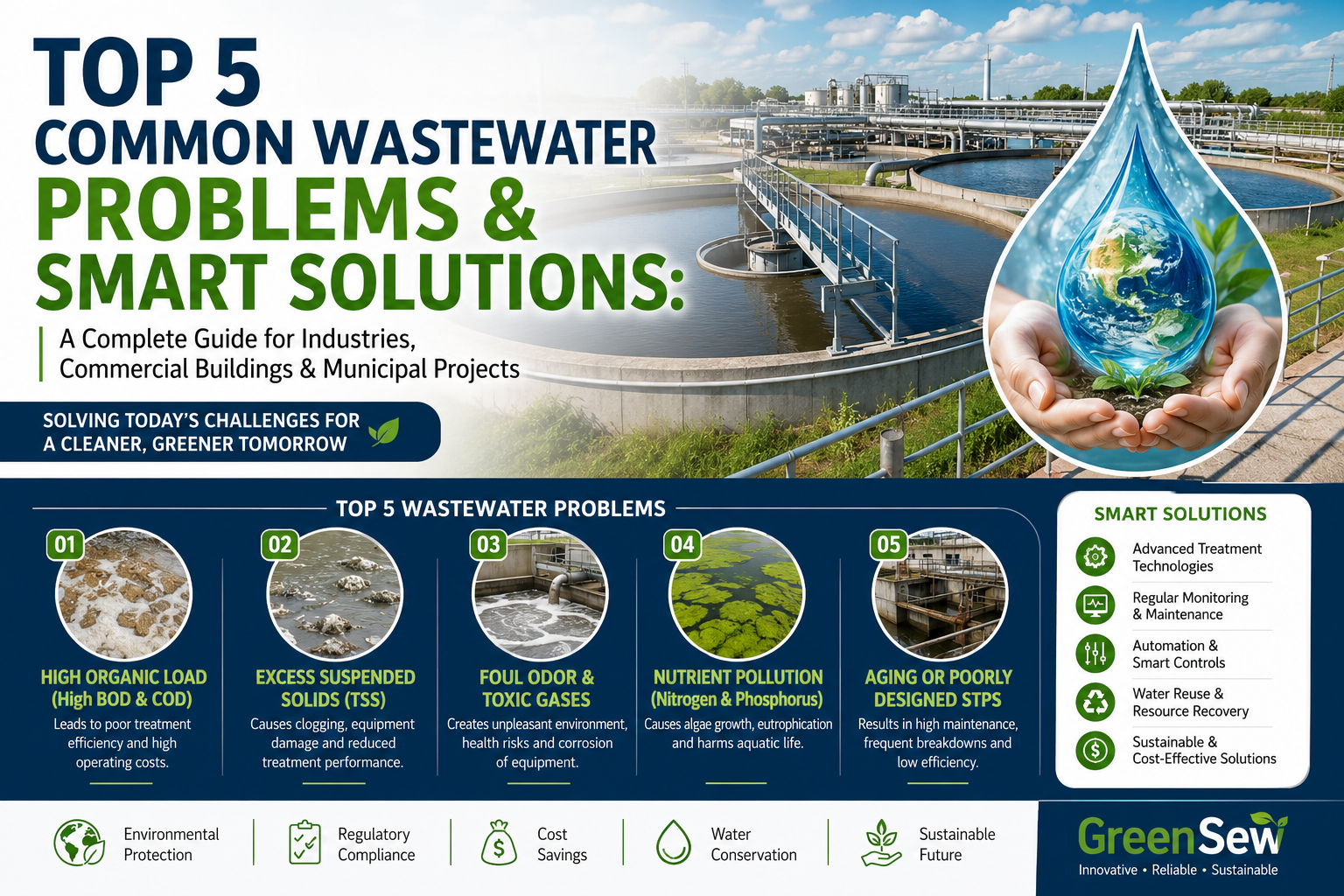
Hyderabad is one of India’s fastest-growing metropolitan cities, with rapid development in residential communities, commercial buildings, IT parks, hospitals, hotels, manufacturing industries and infrastructure projects. As the city continues to expand, the demand for clean water, efficient wastewater management and sustainable water reuse is increasing.
Water is an essential resource for every residential, commercial and industrial establishment. However, increasing water consumption, groundwater pressure, wastewater generation and environmental concerns have made proper water treatment and sewage management more important than ever.
Businesses and property developers in Hyderabad need reliable water treatment plants (WTP) and sewage treatment plants (STP) to manage water resources responsibly, meet applicable environmental requirements and reduce dependence on freshwater sources.
Choosing the right water and wastewater treatment plant solution provider in Hyderabad is an important decision. A properly designed treatment system can improve water quality, support environmental compliance, reduce operating expenses and enable treated wastewater reuse for gardening, flushing, cooling towers and other suitable applications.
GreenSew is an engineering organisation providing water and wastewater treatment solutions for residential, commercial, industrial and municipal applications. With technologies such as easySTP, easySBR, MBBR, MBR, sewage recycling and industrial water treatment systems, GreenSew focuses on practical, efficient and application-specific wastewater engineering.
This guide explains water treatment plants, sewage treatment plants, available technologies, applications, selection criteria, installation considerations and how to choose the right treatment solution provider in Hyderabad.
Hyderabad’s growth has increased the demand for water across several sectors. Large apartment complexes, gated communities, IT companies, hospitals, educational institutions, hotels and industries generate significant quantities of wastewater every day.
Without proper treatment, untreated sewage and industrial wastewater can contaminate water bodies, affect public health and damage the environment.
Some major challenges include:
A properly engineered water and wastewater treatment system helps address these challenges.
Why should Hyderabad businesses invest in treatment plants?
For builders, developers and facility managers, investing in an appropriately designed STP or WTP from the beginning can prevent expensive modifications later.
A Water Treatment Plant (WTP) is a system designed to improve raw water quality by removing unwanted physical, chemical and biological impurities.
Water sources such as borewells, lakes, rivers and municipal supplies may contain suspended particles, dissolved salts, hardness, organic matter and microorganisms.
A WTP uses suitable treatment processes to make water fit for its intended application.
Raw water is collected from the selected source and transferred to the treatment system through pumps and pipelines.
Pressure sand filters remove suspended solids, turbidity and other particulate impurities from water.
Activated carbon filters help reduce colour, odour, chlorine and certain organic contaminants.
Water softeners reduce hardness caused mainly by calcium and magnesium ions.
RO systems use semi-permeable membranes to remove a large proportion of dissolved salts and other contaminants.
UV treatment or chlorination can be used to control microorganisms, depending on the intended application and water quality requirements.
Treated water is stored in a dedicated tank and distributed to the required usage points.
The treatment stages are selected based on raw water analysis and the required treated water quality. Not every WTP requires all these processes.
Long-tail keywords covered:
A Sewage Treatment Plant (STP) is an engineered system that treats wastewater generated from toilets, bathrooms, kitchens, washing areas and other domestic activities.
The main purpose of an STP is to remove suspended solids, organic pollutants and harmful microorganisms from sewage before the treated water is reused or discharged according to applicable standards.
Wastewater contains different types of contaminants, including:
An STP uses physical, biological and chemical treatment processes to reduce these contaminants.
A typical sewage treatment plant consists of the following stages.
The incoming sewage passes through bar screens that remove larger materials such as plastic, cloth, sanitary waste and other floating objects.
Oil and grease are separated to prevent interference with downstream biological treatment processes.
The wastewater is collected in an equalisation tank to balance variations in flow and organic loading.
Microorganisms break down biodegradable organic matter present in sewage. Technologies such as MBBR, SBR and MBR are used depending on the project requirements.
Biological solids are separated from treated wastewater through settling or membrane filtration, depending on the selected technology.
Pressure sand filters, activated carbon filters or other polishing systems may be used to improve treated water quality.
UV disinfection or chlorination helps reduce harmful microorganisms before reuse or discharge.
The treated water is collected in a storage tank and supplied for suitable non-potable applications.
The sludge generated during treatment is collected, thickened and dewatered before appropriate handling and disposal.
The exact process depends on sewage characteristics, treatment capacity, available space, treated water requirements and applicable discharge or reuse standards.
Residential apartments, gated communities and commercial developments generate wastewater every day. Without a properly designed treatment facility, managing this wastewater becomes difficult.
An STP helps:
For large residential communities, an appropriately designed STP is an important part of long-term infrastructure planning.
Long-tail keywords covered:
There is no single treatment technology suitable for every wastewater treatment project. The right technology depends on sewage characteristics, plant capacity, available space, operating conditions, maintenance requirements and treated water quality.
Here are some commonly used sewage treatment technologies.
MBBR is a biological wastewater treatment technology that uses specially designed plastic carrier media inside an aeration tank.
Microorganisms grow on the surface of these carriers and help break down organic pollutants in wastewater.
Advantages of MBBR:
MBBR is commonly considered for apartments, hotels, hospitals, commercial complexes and industrial wastewater applications.
SBR is an activated sludge treatment process in which biological treatment and settling take place in the same reactor in different operating phases.
The treatment cycle generally includes:
Advantages of SBR:
SBR technology is useful for residential communities, commercial buildings, institutions and municipal wastewater treatment applications.
MBR combines biological treatment with membrane filtration. The membrane system separates suspended solids and biomass from treated wastewater.
Advantages of MBR:
MBR may be suitable for premium residential projects, hospitals, hotels and facilities requiring advanced treated wastewater quality.
ASP is a conventional biological wastewater treatment process that uses microorganisms suspended in an aeration tank to remove organic matter.
It generally consists of an aeration tank, secondary clarifier, sludge return arrangement and sludge wasting system.
ASP can be considered for larger installations where sufficient land, trained operation and maintenance infrastructure are available.
Johkasou is a decentralised domestic wastewater treatment approach developed in Japan. It is designed to treat wastewater close to where it is generated.
GreenSew’s easySTP technology is based on this approach and is intended for applications where compact construction, simplified operation and reliable treatment are important.
Key features of easySTP include:
It can be considered for independent buildings, residential communities, hotels, institutions and locations where conventional STP construction is difficult.
Technology | Suitable application |
MBBR | Residential and commercial projects |
SBR | Apartments, institutions and municipal projects |
MBR | Advanced wastewater recycling |
ASP | Larger conventional treatment installations |
Johkasou / easySTP | Decentralised sewage treatment |
The best technology should be selected after evaluating the project’s actual requirements rather than choosing only based on initial equipment cost.
Industrial wastewater is different from domestic sewage. Its characteristics depend on the manufacturing process, raw materials, chemicals and production activities.
Industries may generate wastewater containing:
An industrial wastewater treatment plant must be designed according to the wastewater analysis and final disposal or reuse requirements.
An ETP treats industrial wastewater before it is reused or discharged in accordance with applicable environmental requirements.
RO systems can be used to recover water from suitable treated wastewater streams and reduce dissolved solids.
UF membranes remove fine suspended particles, colloids and microorganisms, depending on membrane specifications.
Sludge dewatering systems reduce the water content of sludge, making storage, transportation and handling easier.
Water recycling systems recover treated water for suitable industrial processes, cooling and utility applications.
GreenSew can help industries evaluate suitable treatment and recycling configurations based on their water requirements and wastewater characteristics.
Long-tail keywords covered:
Water recycling is becoming an important part of sustainable water management in Hyderabad.
Instead of treating wastewater only for disposal, property owners and industries can consider recovering treated water for suitable non-drinking applications.
The city’s increasing focus on treated wastewater reuse highlights this opportunity. In November 2026, HMWSSB introduced a Green Water Tanker initiative to supply treated wastewater for applications such as construction, gardening, landscaping and park maintenance.
The New Indian Express+1
Depending on the treated water quality and applicable permissions, recycled water may be used for:
Reduced freshwater consumption: Treated wastewater can replace freshwater for appropriate non-drinking applications.
Lower water procurement expenses: Reuse can reduce the need to purchase additional freshwater, depending on project economics.
Sustainable building management: Recycled water helps residential and commercial buildings improve their water management practices.
Environmental protection: Proper treatment and reuse can reduce the quantity of wastewater requiring disposal.
Improved resource efficiency: Wastewater becomes a recoverable resource rather than simply a waste stream.
A complete recycling system may include biological treatment, filtration, UF, RO and disinfection, depending on the intended application.
Selecting a treatment plant provider is not simply about comparing quotations. A treatment system must perform consistently throughout its operating life.
Before finalising a company, consider the following factors.
Choose an organisation that understands wastewater characteristics, hydraulic loading, organic loading, treatment processes and plant design.
The provider should be able to recommend a suitable technology based on the project’s actual requirements.
A provider with experience in residential, commercial, industrial and municipal projects can better understand different treatment challenges.
Ask for relevant project references and technical details.
The company should offer suitable technologies such as MBBR, SBR, MBR, ASP or decentralised treatment systems.
Avoid selecting a plant based only on its lowest quoted price.
In Hyderabad, many residential and commercial developments have limited space for treatment infrastructure.
Consider compact solutions where appropriate, and evaluate tank dimensions, equipment access, piping and maintenance clearances.
Electricity is a recurring operating expense.
Evaluate blower efficiency, pump selection, aeration requirements, operating hours and control systems before selecting the treatment plant.
A plant that requires complicated operation can become difficult to manage over time.
Understand the operator requirements, cleaning schedules, chemical consumption, spare parts and maintenance procedures.
The proposed treatment plant must be designed around the applicable regulatory conditions, discharge location and intended reuse.
Ask the provider to explain the relevant treated water quality targets and testing requirements.
A reliable engineering partner should provide technical support, commissioning guidance, troubleshooting and maintenance assistance.
Review the following documents before project approval:
Choosing an engineering-focused treatment provider helps reduce the risk of selecting an unsuitable plant.
Every industry has different water consumption patterns and wastewater characteristics. A treatment plant must be designed according to the specific application.
Residential buildings generate wastewater from bathrooms, kitchens, toilets and washing activities.
An STP helps residential communities treat sewage and reuse treated water for gardening, flushing and other suitable purposes.
Recommended solutions:
Hotels and resorts generate wastewater from guest rooms, restaurants, kitchens, laundry facilities and housekeeping activities.
Their water demand can fluctuate depending on occupancy.
A properly designed STP helps manage wastewater and recover treated water for landscaping, toilet flushing and other approved non-potable applications.
Hospitals generate wastewater from patient rooms, laboratories, kitchens, laundry and sanitation facilities.
Their treatment systems require careful consideration of wastewater characteristics, disinfection and applicable healthcare wastewater management requirements.
IT parks and corporate campuses generate substantial wastewater from washrooms, cafeterias and other utility areas.
STPs can help these facilities reuse treated water for landscaping, flushing and cooling tower applications, subject to suitable treatment quality.
Manufacturing industries need both water treatment and wastewater management systems.
Depending on the production process, they may require raw water treatment, softening, RO, UF, ETP, wastewater recycling and sludge dewatering.
Municipal wastewater treatment projects require reliable engineering, appropriate capacity planning, process selection and long-term operational considerations.
Large-scale projects may require advanced biological processes, automation, sludge management, monitoring systems and treated water recycling infrastructure.
Many customers search for water treatment and wastewater treatment solutions without knowing which type of plant their project requires.
Here is a simple comparison.
Parameter | WTP | STP | ETP |
Full form | Water Treatment Plant | Sewage Treatment Plant | Effluent Treatment Plant |
Main purpose | Treat raw water | Treat domestic sewage | Treat industrial wastewater |
Input | Borewell, surface or other raw water | Domestic sewage | Industrial effluent |
Main contaminants | Suspended solids, hardness, salts | Organic matter, solids, pathogens | Chemicals, salts, oils and process pollutants |
Typical processes | Filtration, softening, RO | Biological treatment, filtration, disinfection | Physical, chemical and biological treatment |
Main application | Water supply | Wastewater management | Industrial wastewater management |
Some projects require only one type of plant, while others need multiple treatment systems.
For example, a manufacturing facility may require a WTP for process water, an STP for domestic sewage and an ETP for industrial wastewater.
One of the most common questions from builders, industrial customers and property developers is: What is the cost of installing a sewage treatment plant or water treatment plant in Hyderabad?
There is no single fixed price because every project has different technical requirements.
The cost of an STP or WTP depends on several factors.
A low initial quotation may not include all the equipment and infrastructure required for proper plant operation.
A cheaper system may eventually involve higher electricity consumption, frequent breakdowns, additional manpower and expensive modifications.
Therefore, customers should compare:
The right approach is to compare the total cost of ownership, not just the initial purchase price.
For an accurate quotation, a treatment plant provider should evaluate the wastewater quantity, raw water analysis, required treatment quality, site conditions and project specifications.
Selecting the correct STP capacity is one of the most important steps in wastewater treatment plant planning.
An undersized STP may struggle to handle the wastewater load, while an oversized STP can increase capital costs and create operational problems.
The basic calculation is:
\[ \text{STP Capacity (KLD)} = \frac{\text{Population}\times\text{Water Consumption (LPCD)}\times\text{Wastewater Factor}}{1000} \]
Here:
Assume:
Total population:
200 × 4 = 800 people.
Daily water consumption:
800 × 135 = 108,000 litres/day.
Estimated wastewater generation:
108,000 × 80% = 86,400 litres/day.
Therefore:
EstimatedSewageGeneration=86.4KLD
The preliminary STP capacity is approximately 86.4 KLD. The final design capacity must account for actual occupancy, peak flows, wastewater characteristics and project-specific engineering margins.
This calculation demonstrates why builders should not select STP capacity simply by considering the number of apartments.
GreenSew can help builders, consultants and developers evaluate sewage generation and select an appropriate treatment solution.
Long-tail keywords covered:
Choosing a water and wastewater treatment plant provider requires confidence in engineering, technology, installation and ongoing technical support.
GreenSew Infratech Pvt. Ltd. focuses on practical water and wastewater engineering solutions for residential, commercial, industrial and municipal applications.
Its approach is based on understanding the actual project requirements and recommending suitable treatment technologies.
A compact decentralised sewage treatment solution based on Johkasou technology, designed for suitable residential, commercial and institutional applications.
A solution offering for municipal and decentralised sewage treatment requirements.
A sequencing batch reactor-based treatment solution for suitable sewage treatment applications.
Biological wastewater treatment using moving bed biofilm carrier technology.
Membrane bioreactor solutions for projects requiring advanced wastewater treatment and recycling.
Solutions designed to recover treated wastewater for appropriate non-potable applications.
Sludge management and desludging-related solutions.
Water treatment solutions based on raw water characteristics and required treated water quality.
Advanced filtration and water recovery solutions for suitable wastewater recycling requirements.
Online monitoring solutions for parameters such as flow, pH, TSS, BOD and COD, depending on the monitoring configuration and project requirements.
Mechanical sludge dewatering technology designed to reduce sludge volume and simplify handling.
GreenSew focuses on:
The objective is to engineer treatment systems that work reliably under real operating conditions, rather than focusing only on equipment supply.
GreenSew and its associated Indus Ecowater business have worked across different wastewater treatment applications.
Some notable project references include:
Project | Capacity | Technology/application |
Kudligi project | 4.6 MLD | Municipal STP |
AP High Court | 250 KLD | MBR |
Godrej Aqua | 400 KLD | SBR |
AP Central University, Anantapur | 300 KLD | SBR |
Swaraj Maidan, Vijayawada | 50 KLD STP + 150 KLD WTP | STP and WTP |
These project references demonstrate the range of treatment applications that require different engineering approaches.
GreenSew’s focus is to provide suitable solutions based on project size, wastewater characteristics and long-term operating requirements.
Environmental compliance is an important consideration when installing and operating water and wastewater treatment plants.
In Hyderabad, project owners should understand the applicable requirements of the Telangana State Pollution Control Board (TSPCB), Central Pollution Control Board (CPCB), local authorities and other relevant regulatory bodies.
Depending on the project, requirements may include:
Some important parameters monitored during sewage treatment include:
Parameter | What it indicates |
pH | Acidity or alkalinity of water |
BOD | Biodegradable organic pollution |
COD | Chemically oxidisable pollutants |
TSS | Suspended particles |
TDS | Total dissolved solids |
Fecal Coliform | Indicator of fecal contamination |
For example, India’s notified STP discharge standards specify BOD limits of 20 mg/L for listed metropolitan cities, including Hyderabad, and 30 mg/L for other areas, with corresponding TSS and fecal coliform requirements. However, project-specific permissions may prescribe stricter standards.
Indian Kanoon+1
The treated water quality required for gardening, toilet flushing, industrial reuse or discharge may differ.
Therefore, an STP should always be designed according to the applicable project approval and intended reuse or discharge requirements.
Hyderabad’s future development depends on responsible water management.
With increasing demand from residential developments, commercial buildings, manufacturing industries and infrastructure projects, treated wastewater can play an important role in reducing freshwater requirements.
Recent initiatives by HMWSSB to promote treated wastewater distribution for construction, landscaping and industrial applications indicate the growing importance of wastewater recycling in the city.
The New Indian Express+1
Property developers and industrial organisations should consider wastewater recycling during the initial planning stage.
A well-designed treatment and recycling system can help:
GreenSew believes in engineering practical water and wastewater solutions that support sustainable development.
Water and wastewater treatment requirements are increasing across Hyderabad and its surrounding industrial and residential development zones.
Some important locations include:
Location | Common treatment requirements |
Hitech City | IT parks, commercial STPs and recycling |
Gachibowli | Residential and commercial STPs |
Financial District | Corporate campuses and wastewater recycling |
Kokapet | High-rise residential and commercial STPs |
Narsingi | Apartment sewage treatment plants |
Miyapur | Residential community STPs |
Kukatpally | Commercial and residential wastewater treatment |
Uppal | Industrial and residential water treatment |
Nacharam | Industrial wastewater treatment |
Jeedimetla | Industrial ETP and WTP |
Patancheru | Industrial wastewater management |
Shamshabad | Commercial, institutional and industrial treatment |
Medchal | Industrial and residential water treatment |
Bachupally | Residential and educational institution STPs |
Kondapur | Apartment and commercial sewage treatment |
GreenSew can help customers evaluate suitable water and wastewater treatment technologies for projects across Hyderabad and other locations in Telangana.
One common mistake made by builders and developers is considering the treatment plant only after the main building construction is completed.
This can result in space constraints, additional civil work, complicated piping and increased installation costs.
Planning the treatment plant during the initial design stage offers several advantages.
Better space planning: Allocate sufficient space for tanks, pumps, blowers, filters and maintenance access.
Simplified piping: Plan sewage collection, treated water distribution and separate plumbing systems.
Lower modification costs: Avoid unnecessary reconstruction and changes during later project stages.
Suitable technology selection: Compare different treatment technologies before finalising the building layout.
Improved future maintenance: Ensure easy access to equipment, electrical panels and treatment units.
Builders, architects, MEP consultants and project engineers should coordinate with the STP and WTP engineering team during the planning stage.
The right provider should have engineering capabilities, suitable treatment technologies, relevant project experience, installation expertise and after-sales support. GreenSew provides water and wastewater treatment solutions for residential, commercial, industrial and municipal applications.
A water treatment plant treats raw water to make it suitable for a specific application. A sewage treatment plant treats domestic wastewater to remove organic pollutants, suspended solids and microorganisms before reuse or discharge.
MBBR, SBR, MBR and Johkasou-based systems can be considered for residential apartments. The right technology depends on sewage quantity, available space, budget, treated water requirements and maintenance capabilities.
The cost depends on treatment technology, tank construction, equipment specifications, automation, installation requirements and treated water quality. A technical evaluation is necessary to prepare an accurate quotation.
Yes. Properly treated and tested wastewater can be used for gardening and landscaping when it meets the applicable reuse requirements.
Yes. Treated wastewater can be used for toilet flushing when the treatment quality meets the required standards and a separate treated water distribution system is provided.
The space requirement depends on the plant capacity, treatment technology, tank dimensions, equipment arrangement and maintenance access. Compact systems may help reduce the required installation footprint.
MBBR uses carrier media to support biological growth, while SBR uses a batch-based biological treatment cycle involving aeration, settling and decanting. Both technologies can provide effective sewage treatment when correctly designed and operated.
Not necessarily. It depends on the industrial process. Some industries require WTP systems for raw water treatment and ETP systems for industrial wastewater treatment. They may also require STPs for domestic sewage.
GreenSew offers municipal sewage treatment solutions, including easySTP-Municipal and other application-specific treatment technologies.
Generally, the following details are required:
Yes. GreenSew offers sewage recycling and advanced treatment solutions, including suitable UF and RO-based configurations, depending on project requirements.
Water conservation, wastewater management and environmental protection are becoming essential parts of Hyderabad’s infrastructure development.
Whether you are developing a residential apartment, commercial building, hospital, hotel, IT campus, manufacturing facility or municipal infrastructure project, choosing the right water and wastewater treatment system is important for long-term performance.
A properly engineered WTP or STP helps improve water management, reduce freshwater consumption, support environmental compliance and create opportunities for treated wastewater reuse.
GreenSew Infratech Pvt. Ltd. offers practical engineering solutions across water treatment, sewage treatment, industrial wastewater treatment, municipal STPs and wastewater recycling.
With technologies such as easySTP, easySBR, MBBR, MBR, Sewage Recycle, DeSilta and advanced water treatment systems, GreenSew aims to deliver treatment solutions suited to real-world operating conditions.
Looking for a reliable water treatment plant or wastewater treatment plant solution provider in Hyderabad?
Connect with GreenSew to discuss your project requirements and identify the right treatment solution for your application.
Water Treatment | Wastewater Treatment | Municipal STPs | Sewage Recycling
Let’s engineer better water solutions for a sustainable future.
1800-102-3570
Hyderabad, Telangana, India

With over two decades in the water treatment business, I pioneered bulk pure water distribution and now lead the way in sustainable sewage treatment with easySTP, inspired by Japan’s Johkasou technology. My vision includes widespread adoption and expansion through a new factory and sewage academy.
With over two decades in the water treatment business, I pioneered bulk pure water distribution and now lead the way in sustainable sewage treatment with easySTP, inspired by Japan’s Johkasou technology. My vision includes widespread adoption and expansion through a new factory and sewage academy.
SUBSCRIBE to our monthly NEWSLETTER